Monday, January 22, 2018

Digital Scholarship Consultation Hours in University Library Continues From 16 January, 2018

Digital Scholarship Consultation Hours service has been commenced since  October 2017 to provide instant discussion and advice to any walk... thumbnail 1 summary
Digital Scholarship Consultation Hours service has been commenced since October 2017 to provide instant discussion and advice to any walk-in users with questions on:

  • Using the facilities of the Digital Scholarship Lab
  • Software and tools in the Lab such as ArcGIS, Gephi, Omeka and Voyant Tools
  • Locating data sources
  • Applying digital scholarship research methodologies and visualising data
  • Copyright issues on the use of research data and materials.
On every alternate Tuesday, the Digital Scholarship team does have interesting in-depth discussion and demonstration with academics and postgraduates that come to the Lab. The service will continue in this second semester starting from 16 January 2018 (Tue) on every alternate Tuesday during term time:

Date: 16 & 30 January
        13 & 27 February
        13 & 27 March
        10 & 24 April

Time: 3:00 – 5:00 p.m.

Venue: Digital Scholarship Lab, G/F, University Library

CUHK colleagues and students are welcome to visit us for an instant discussion of your research, or email to dslab@lib.cuhk.edu.hk your question for help!


Thursday, May 18, 2017

The first CUHK Library Digital Scholarship Symposium “Exploring Digital Scholarship Research at CUHK and Beyond” held successfully

On 31 March 2017, the CUHK Library organized the first Digital Scholarship Symposium with the theme “ Exploring Digital Scholarship Re... thumbnail 1 summary

On 31 March 2017, the CUHK Library organized the first Digital Scholarship Symposium with the theme “Exploring Digital Scholarship Research at CUHK and Beyond” that was held at the Digital Scholarship Lab, G/F of University Library.  Six speakers from different disciplines presented their latest digital scholarship projects, attracting over 60 researchers, research students and librarians.

As a 1st anniversary event of the Digital Scholarship Lab, the Symposium aims at providing an avenue for all scholars interested in and conducting research in digital scholarship to get together to share their research, to further spark off more research in this area, and to enhance the partnership between the CUHK Library and the Faculty in conducting and supporting digital scholarship research.


The Symposium was officiated by Prof. Fanny M.C. CHEUNG, Pro-Vice-Chancellor/Vice-President and Ms. Louise JONES, University Librarian of CUHK. There were six presentations on network analysis, data visualization, GIS and big data analysis. They were:
  1. Prof. HUANG Bo from Department of Geography and Resource Management, CUHK: GIS and Big Data for Urban Applications
  2. Prof. LAI Chi-Tim from Department of Cultural and Religious Studies, CUHK: Guangzhou Daoist and Popular Temples Studies and the Development of Daoist Digital Museum
  3. Ms. Kitty Siu from Library, CUHK: A Collaborative Project in Opening Research Data: Archaeological Sites Mapping in China with GIS
  4. Dr. TSUI Lik-hang from China Biographical Database Project (CBDB), Harvard University: A Cyberinfrastructure for Studying Chinese History: A Proposal Based on the Experience of the China Biographical Database Project
  5. Prof. Angela WU from School of Journalism and Communication, CUHK: Re-presenting Web Use as Networks
  6. Prof. Michelle YE from Department of Translation, CUHK: The Social Network of an Early Republican Literary Magazine: a Visualization with Gephi


The post-symposium workshop in the afternoon by Dr. Tsui introduced the use of China Biographical Database (CBDB) and incorporation in other tools such as MARKUS for China studies.  The digital tools presented in the workshop sparked very lively discussion among participants.  More photos about the symposium can be found here.


The Library is very grateful for the enthusiastic support from the Faculty and the participants. The Library will continue to support research activities across the entire research life cycle by leveraging the latest digital technologies.

Tuesday, October 4, 2016

Open Access Day (24 Oct 2016)

The Open Access Day is to share with the University community the benefits of opening up research. Themed as “ Open in Action – Enhancin... thumbnail 1 summary


The Open Access Day is to share with the University community the benefits of opening up research. Themed as “Open in Action – Enhancing Research Impact @CUHK AIMS”, the event is tied in with the International Open Access Week to highlight the needs of taking action now to open up research through the new Academic Information Management System (AIMS) and the institutional repository Research Portal. This new system provides a new avenue for the dissemination of research outputs, showcasing the research excellence of the University and facilitating international networking and collaboration. Opening and sharing research is the means to reap these benefits.
A mixture of programmes are organized below running from 10:00 a.m. to 5:00 p.m. on that day. The Opening Ceremony will be held at the Beacon and officiated by Prof. Benjamin Wah, Provost, Prof. Fanny Cheung, Pro-Vice-Chancellor / Vice-President, Prof. Lutz Christian Wolff, Dean of the Graduate School, Prof. Walter Ho, Director of ORKTS, and Ms. Louise Jones, University Librarian. You are welcome to register at here.

Open Access Day Programme

Time Program Speaker(s) / Officiating Guests Venue
10:00-17:00
Exhibition on Open Access
(On display until 31 October 2016)
Self Service Area,
G/F, University Library
Hands-on trial of AIMS
Seminar Room,
Digital Scholarship Lab, G/F, University Library
10:00-11:00
Open Access Publishing Talk - Global Trends on Open Access Publishing – the view from Taylor & Francis
Ms. Lyndsey DIXON
Regional Journals Editorial Director, APAC, Taylor & Francis
User Education Room 1,
G/F, University Library
11:00-11:45
Open Access Publishing Talk - Cambridge University Press and Open Access -
A University Publisher’s Perspective
Mr. Joe NG
Acquisitions Editor for Law
and Social Sciences,
Cambridge University Press
12:00-12:30
Opening Ceremony
Officiated by

Professor Benjamin W. WAH
Provost
 Professor Fanny M.C. CHEUNG
Pro-Vice-Chancellor/Vice-President
Professor Lutz-Christian WOLFF
Dean, Graduate School
Professor Walter K. K. HO
Director, Office of Research and Knowledge Transfer Services
 Ms. Louise JONES
University Librarian
Digital Scholarship Lab, G/F, University Library

(FaceBook Live Broadcast)
12:30-13:00
A Dialogue between Provost and University Librarian – Open Access in Action
Professor Benjamin W. WAH
Provost
Ms Louise JONES
University Librarian
14:30-15:30
Open Access in Different Perspectives – Experience Sharing with CUHK Faculty
Professor Chi Tim LAI
Professor, Department of Cultural and Religious Studies, Faculty of Arts
Professor Jyh-An LEE
Assistant Professor,
Faculty of Law
Professor Edmund Anthony Severn NELSON
Clinical Professional Consultant,  Department of Paediatrics,
Faculty of Medicine
Professor C. M. Jimmy YU
Head, United College
Professor, Department of Chemistry, Faculty of Science
Visualisation Room, Digital Scholarship Lab, G/F, University Library
16:00-17:00
Repositories - institutional, subject and social – conflict or connectivity?
Mr. Aaron TAY
Manager, Library Analytics & Research Librarian, Accounting, Singapore Management University Library
Visualisation Room, Digital Scholarship Lab, G/F, University Library
(Webinar)

Wednesday, March 23, 2016

Research Café on Culture and Translation @ Digital Scholarship Lab (24 March 2016)

The sixth  Research Café   will be held at the brand new Digital Scholarship Lab . The theme will be on  Culture and Translation . The ... thumbnail 1 summary


The sixth Research Café  will be held at the brand new Digital Scholarship Lab. The theme will be on Culture and Translation. The Research Café organized by the Library is to provide a series of informal and engaging events for research postgraduate students to get together, present their research, exchange ideas across disciplines, network, and polish presentation skills.   CUHK postgraduates, academics and researchers are all welcome to attend!  This Café will consist of a sharing talk on modern Chinese literature and translation by Prof. Connie Kwong of Dept. of Chinese Language and Literature, and two presentations by research postgraduate students on culture and translation.  Dr. Benson Lee of The Independent Learning Centre, will provide feedback on student presentation skills.

Date: 24 March 2016 (Thu)
Time: 4:00 p.m. - 5:30 p.m.
Venue: Digital Scholarship Lab, G/F, University Library
Languages: Chinese and English

     Light refreshment will be provided.

I. Short Talk: Modern Chinese Literature and Translation
   Speaker: Prof. KWONG Ho Yee Connie, Associate Professor, Dept. of Chinese Language and Literature

II. Presentations:
·         The Demon as Poetic Metaphor and “Mahayana” of Art: Tian Han’s Transcultural Reflections of Charles Baudelaire (Presentation in Putonghua)
By Yiyang XI, Ph.D. Candidate in Cultural Studies, Department of Cultural and Religious Studies
·         Translation as Research: William H. Nienhauser’s Translation of the Shiji in Chinese and Western Historiographical Contexts (Presentation in English)
By Li LI, Ph.D. Student, Department of Translation
Moderator: Prof. KWONG Ho Yee Connie
Feedback on Presentation Skills: Dr. Benson LEE, Lecturer, The Independent Learning Centre

Register to attend: Complete the Online Registration Form


Thursday, March 17, 2016

Just a few hours to go: The Digital Scholarship Lab will open officially on March 17 at 3:00 p.m.

In these few weeks, the team members of Research Support & Digital Initiatives stayed in the Digital Scholarship Lab days and nights to ... thumbnail 1 summary
In these few weeks, the team members of Research Support & Digital Initiatives stayed in the Digital Scholarship Lab days and nights to prepare for the opening of the Lab.


We are all excited about this great day, but we are also nervous and worrying.  Time is the biggest enemy. The site was handed over to the Library on March 7; there are only 10 days to prepare not just for the opening ceremony but also the ongoing operation right after the opening ceremony. More were done, but many more still coming, and many are unexpected!

Yet, the whole team work hand-in-hand to achieve this finally. We have spent weeks to discuss how to modify the interface of the control program to make it as intuitive as possible so that users will find it easy to use, it was only completed one day before the opening. We attended the training on the use of the digital display wall, yet still not familiar until the last two or three days. New computer equipment cannot be delivered until the last two days. Color tuning of the LED TV can only be completed one day before the opening because one of the TV was defective and need replacement.

Many hours of work were used to design the program for unveiling the digital display wall; still much more time was used to select the digital content for display and how to design the flow so that the demonstration can be as smooth and stunning as possible. A lot of mathematical calculation was needed to ensure that the digital backdrop can be projected to the wall without any distortion and in high quality. The technical set up of the digital display wall need to be changed to meet the needs of the opening ceremony. We have to adapt to the new setting, and even during rehearsal, we did not know why some setting did not work. We worried about the late arrival of furniture, yet good news coming that they can be delivered one week before, so much help with this.

We would like to share a few photos here showing how the lab grows. From construction to the installation of the digital display wall to the physical set up of the lab to the preparation of the opening, every step is new to us and every step enhances our belief that the Lab will be useful to our users.

The construction site

The frame for the digital display wall

The digital display wall is on testing
Early arrival of furniture
Easily configurable tables and chairs for discussion and collaboration

Replacement of a defective LED TV

Vendors helping to set up the site for the opening ceremony
Inside the server rack


Setting up the equipment for demonstration at the opening ceremony


Preparing the installation of physical backdrop

The stunning physical backdrop was installed

The digital backdrop also ready now

Setting the lab for the opening ceremony

Specialist software for digital scholarship research on high-performance computers

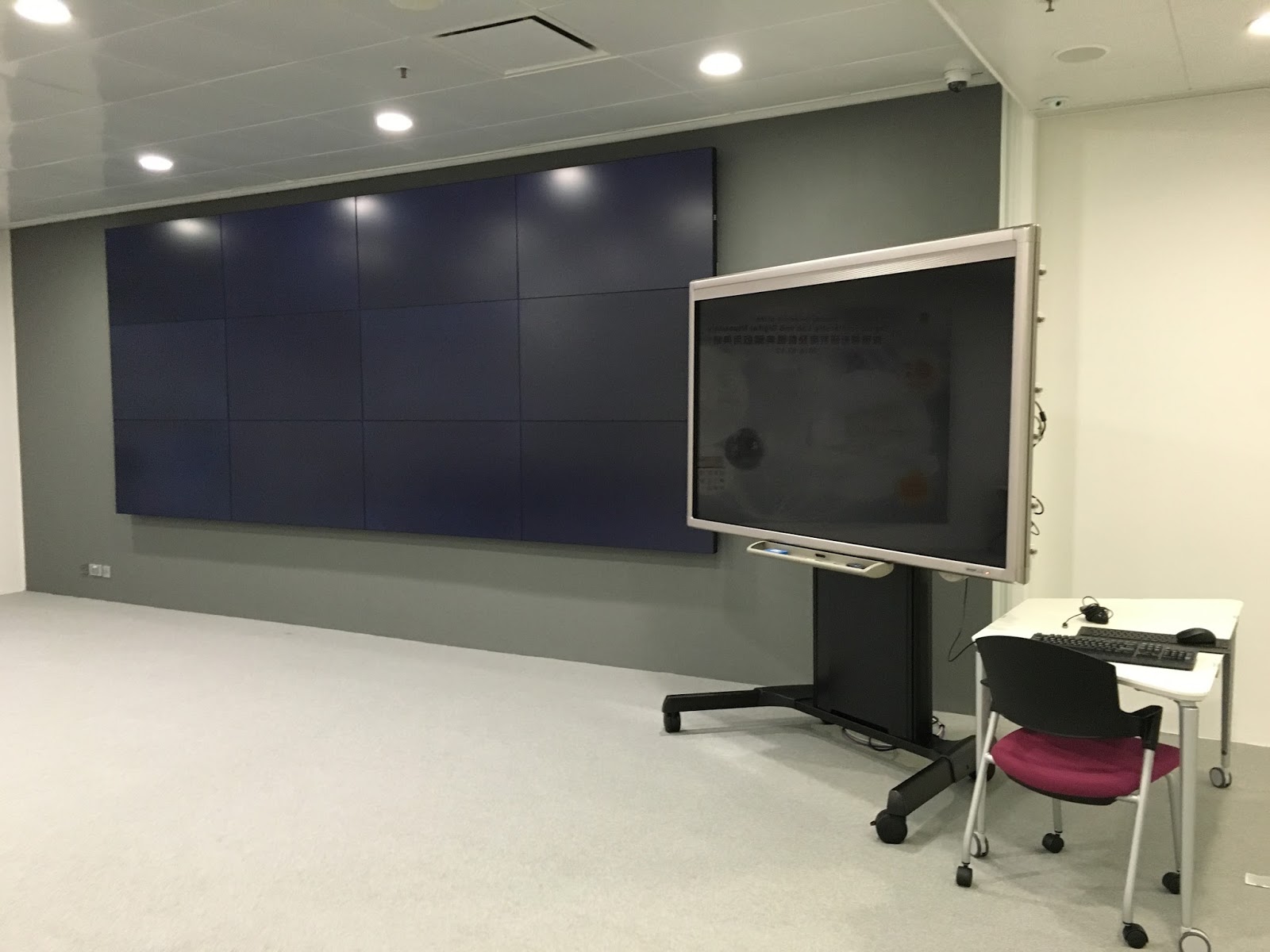
The digital display wall and the 80-inch interactive white board

The Lab is the place to innovate, to experiment, to immerse in research, to get together, and many more. It is actually the place for you.

We have prepared.  Your turn now to use this Lab!

Please join us in the opening ceremony on March 17, 2016 at 3:30 p.m. in the Digital Scholarship Lab.



Monday, March 7, 2016

Countdown to the Opening of the Digital Scholarship Lab – A large digital display wall to transform scholarship

The first ever Digital Scholarship Lab in Hong Kong is going to be established at CUHK Library at G/F, University Library, on March 17, 2016... thumbnail 1 summary
The first ever Digital Scholarship Lab in Hong Kong is going to be established at CUHK Library at G/F, University Library, on March 17, 2016. There are only a few more days to go. Please stay tuned with our updates.


The Digital Scholarship Lab is established to support e-Research at the University by leveraging the latest digital technologies. One of its key features is a huge 6.4 (H) x 15.9 (W) foot digital display wall that is built from twelve nos. of 55-inch high-resolution LED TV screens to provide an extremely high resolution of 24,883,200 pixels (7,680 pixels x 3240 pixels) in the following configuration.


There are 12 inputs for displaying your sources simultaneously from different devices such as tablets, notebooks, smart phones, etc. on the TV screens in different layouts such as one input source across all 12 TV screens or 2 inputs, each occupying 6 TV screens. You can easily select the screen layouts from a control panel installed on an iPad mounted on the wall of the Lab. Other inputs provided are Apple TV, blu-ray, an interactive white-board and a wireless presenter. You can easily plug in your device to the socket on the table top.    

How can the display wall help your research?

The purpose of installing this huge display wall is to offer a new perspective for research that is not possible with a normal desktop computer. The following is a few ways the display wall can help transform scholarship.
  • The display wall is ideal for visualizing large images and exploring big data. With ultra-narrow bezels of 3.5 mm, the 12 TV screens can be linked together with nearly invisible edges to form one single display for showing high resolution images in much greater detail to maximize the visual impact. It can also support the display of high-definition 4K images on a 2 x 2 configuration. Take for example; these high-definition TV screens can be used to display genomics data or brain images more clearly than a standard computer. By zooming in and out of the images, you will be able to visualize large-scale microarray data to facilitate discovery of more patterns and trends, and to enable more detailed analysis of relationship between patterns. The big data which can be dense and hard to identify on a desktop display is more visible on a large display, making the digital information more visual. This feature of the wall will make research more accessible.  

  • By showing your sources of data on the TV screens simultaneously in different layouts, you are be able to view either two images side-by-side for more detailed comparison or several images together for discussion. In this website (http://earthobservatory.nasa.gov/IOTD/view.php?id=84833), you can easily spot the change in landscape by viewing the images side-by-side in a large display wall. Again, this is not possible in a standard computer with a much smaller screen. The overall vision is improved and your spatial memory is also enhanced.

  • The display wall is able to support multiple video and audio inputs from DVI-D, DVI-I, HDMI, DisplayPort and VGA independent of the devices. By bringing in your own devices, you can display any information on the wall to immerse in your research.

  • The display wall also breeds experimental and collaborative work. By being able to display sources from different devices simultaneously on the giant screen, researchers can work collaboratively in a team in the Lab to share screens and work on the research data together. You are able to build not only a community of scholars but also can collaborate better. Postgraduates can also make use of the display wall to do group research projects. They are able to experiment with the technology, learn from messing around the images on their own and may be able find innovative way of making use of the display wall.

  • Collaborative teaching and learning can also take place in the Lab. The display wall allows students and professors to share information from their own laptops. Professors can easily comment on the students’ work by routing students’ displays and students can learn from each other collaboratively.

There are a lot of possibilities in using the display wall. Academic work, collaborative sessions, teaching, seminars and even thesis defenses are also feasible. Please do not hesitate to reserve the Lab, details of which will be announced later.